E-Scooter
Educational project: kick-sharing app (UX/UI design course, Netology)
My roles:
timeline:
2018-2019
results:

Studied and applied all stages of product design in practice



Context
The student project topic was selected at the end of 2018, at the dawn of Moscow’s electric scooter rental market. This provided ample research opportunities and closely simulated real-world conditions.
Our research and design team progressed through all major stages of product development:
- Conducting audience research (Segmentation/Personas, Customer Journey Mapping)
- Defining product value and key advantages (Lean UX strategy)
- Pitching ideas
- Developing primary use cases
- Designing information architecture and interface layout
- Prototyping
- Initial usability testing
- UI design: mood boards, style guide, app interface design
- Iterative testing
- Creating the product landing page and delivering the final presentation
User Research & Analysis
We explored possible kicksharing use cases and defined key user segments. Persona profiles were created for each segment to guide the next stages of the design process.
Solo ride
Tasks:
Characteristics:
- Get to the park
- Walk the dog
- Unwind after work
Characteristics:
- Only one scooter needed
- Routes may be irregular, but usually known before the ride

Mikhail Malinovsky, 26
General Background:
Single, works in an office. Uses a scooter more for leisure than for transportation
Context of Use:
On summer evenings after work, sometimes takes a scooter for a ride in the park. Enjoys riding, sitting in the park, reading, then heading home
Usage Goals:
General Background:
Single, works in an office. Uses a scooter more for leisure than for transportation
Context of Use:
On summer evenings after work, sometimes takes a scooter for a ride in the park. Enjoys riding, sitting in the park, reading, then heading home
Usage Goals:
- Save time getting to the park
- Stretch and get some activity after a sedentary workday
Important:
Sufficient battery charge to return back
Nice-to-have:
Sufficient battery charge to return back
Nice-to-have:
- Photos of scooters
- Scooter specifications (speed, weight, etc.)
Fears:
- The scooter might run out of battery while Mikhail is sitting in the park
- Phone battery could die, preventing the rental from being completed
Ride with friends
Tasks:
Characteristics:
- Relax and have fun
- Gain new experiences
Characteristics:
- Needs multiple scooters at once
- Not in a hurry
- Trips usually on weekends or in the evenings

Igor Gladkov, 28, Marketer
General Background:
Due to work, he can only meet friends for a limited time on weekends or in the evenings. Single, enjoys drinks and good food. Does not like public transport
Context of Use:
When walking becomes boring, the scooter comes to the rescue
Usage Goals:
Spend time with friends while being able to visit multiple places
General Background:
Due to work, he can only meet friends for a limited time on weekends or in the evenings. Single, enjoys drinks and good food. Does not like public transport
Context of Use:
When walking becomes boring, the scooter comes to the rescue
Usage Goals:
Spend time with friends while being able to visit multiple places
Important:
Nice-to-have:
- Ability to rent multiple scooters at once for a group
- Move between pre-known locations with the option to leave the scooter anywhere
- Easy start and end of the rental
Nice-to-have:
- A large number of scooters available
- Scooters conveniently located near entertainment venues
Fears:
- Not enough scooters available for everyone in the group
- Scooter suddenly runs out of battery during the trip
Ride with children
Tasks:
Characteristics:
- Relax and have fun with family
- Gain new experiences
Characteristics:
- Needs multiple scooters at once
- Not in a hurry
- Trips usually on weekends

Alexei Ivanchenko, 34
General Background:
Married, with children aged 4 and 10. Enjoys traveling and spending active time outdoors with the family
Context of Use:
The scooter is a convenient way for the whole family to get around on weekends
Usage Goals:
Make family outings more diverse by being able to move around with the kids. Children don’t get tired = mobility for the whole family
General Background:
Married, with children aged 4 and 10. Enjoys traveling and spending active time outdoors with the family
Context of Use:
The scooter is a convenient way for the whole family to get around on weekends
Usage Goals:
Make family outings more diverse by being able to move around with the kids. Children don’t get tired = mobility for the whole family
Important:
Nice-to-have:
- Child safety
- Ability to rent scooters for both self and children on a single account
- Scooters in proper working condition
Nice-to-have:
- Availability of scooters for the whole family in one location
- Option to get additional equipment for riding with a child on a single scooter
- Helmets provided
- Choice of scooter color
Fears:
- No scooters available for the children or scooters are not working properly
- Scooter breaking down during the ride
Commute
Tasks:
Get to university quickly
Characteristics:
Get to university quickly
Characteristics:
- Needs a scooter readily available with sufficient battery charge
- Wants to avoid registration hassle — just grab and go

Irina Kazakova, 21, Student
General Background:
Studies at a university close to home. Doesn’t own a car, and public transport can be slow or stuck in traffic
Context of Use:
Regularly travels the same routes at the same times
Usage Goals:
General Background:
Studies at a university close to home. Doesn’t own a car, and public transport can be slow or stuck in traffic
Context of Use:
Regularly travels the same routes at the same times
Usage Goals:
- Avoid spending money on buying a scooter
- Always have a scooter available where needed
Important:
Nice-to-have:
- Know where to pick up a scooter and reserve it
- Use it quickly and hassle-free
- Ensure sufficient battery charge
- Know the exact travel time
Nice-to-have:
- Know the shortest route
- Ability to recharge from the scooter along the way
- Know in advance the exact number of scooters available at a location
Fears:
- Not finding a scooter at the needed location
- Battery running out
- Scooter malfunction
- Not being able to leave the scooter at the desired location
Tourist ride
Tasks:
Characteristics:
- Quick sightseeing
- Trips aimed at saving time
- Ability to plan the route independently
Characteristics:
- Poor knowledge of the city
- Route through key points is not well thought out

Jonas, 28, Germany
General Background:
Visiting Russia for the first time to meet his relatives (recently married to a Russian). An active tourist who cycles a lot at home. Speaks Russian at a basic level – understands and can use simple phrases, but struggles with more complex communication
Context of Use:
Wants to ride around the Boulevard Ring and the city center alone
Usage Goals:
General Background:
Visiting Russia for the first time to meet his relatives (recently married to a Russian). An active tourist who cycles a lot at home. Speaks Russian at a basic level – understands and can use simple phrases, but struggles with more complex communication
Context of Use:
Wants to ride around the Boulevard Ring and the city center alone
Usage Goals:
- Explore the center of Moscow
- See as much as possible in a single day
Important:
Nice-to-have:
- Ability to travel both by scooter and public transport
- Flexibility with an unpredictable destination
Nice-to-have:
- Powerful scooter (there are slopes along the Boulevard Ring)
- Lightweight scooter (sometimes needs to be pushed or carried)
- Suggestions for interesting places and routes
- Map view with GPS
Fears:
- Unfamiliarity with Russian roads and driving culture
- Fear of getting confused with the rental system
- Not having enough time to see all the sights
- Getting lost in the city
B2B (delivery)
Tasks:
Characteristics:
- Fast delivery of small parcels
- Continuous access to scooters
- Postpaid billing (after a month of use)
- Saving on delivery costs
Characteristics:
- Continuous access to a set number of scooters
- Ability to rent one (or several) scooters on an ongoing basis
- Contract signing and managing transactions

Elena Sokolova, 35
General Background:
Owner of a small flower shop. She wants to improve her business through timely deliveries. Likes making people happy and values smiles
Context of Use:
Usage Goals:
Save time and money on deliveries
General Background:
Owner of a small flower shop. She wants to improve her business through timely deliveries. Likes making people happy and values smiles
Context of Use:
- Improving delivery service
- Taking care of customers
- Creating a competitive advantage
Usage Goals:
Save time and money on deliveries
Important:
- Access to one or several scooters on a regular basis
- Receiving accounting/invoice documents
- Ability to pay for the service at the end of the reporting period
- Safety of the courier and the goods during transport
Fears:
- Losing business due to customer dissatisfaction with delivery times
- Losing money due to scooter malfunctions during use by couriers
- Competitors taking advantage of her experience
We developed Customer Journey Maps for the key user segments:


Product Strategy & Interface Architecture
We followed a Lean UX approach to design and test the product. Using insights from previous stages, we built an influence map, highlighted key user pain points, and prioritized them with ICE scoring.
At the same time, we calculated a business model using open data and competitor analysis. An MVP plan was developed, outlining core hypotheses, how to test them, and relevant success metrics.

Next, we designed the information architecture and interface layout, ensuring that all necessary features and data handling requirements were addressed.
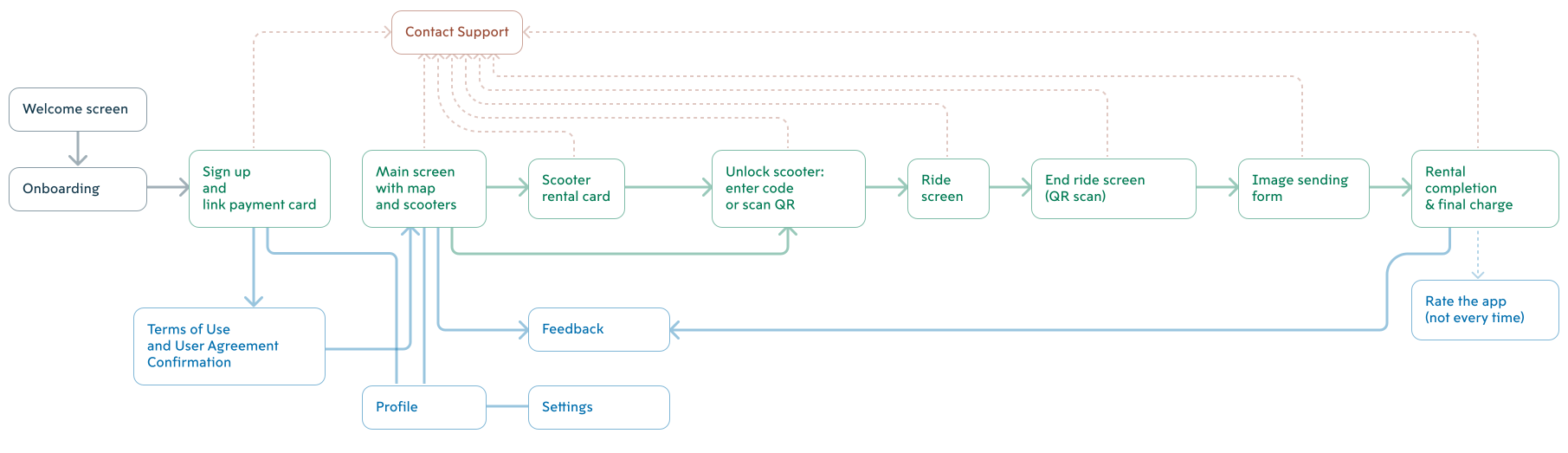
Based on the finalized application structure, a low-fidelity prototype was created. Key usage scenarios were tested on this prototype.

UI Design and High-Fidelity Prototyping
To shape the design concept, we collected several reference boards covering overall visual direction, map design, and logo exploration. Using these references, each team member developed their own design concept.
I proposed a dark visual concept with a minimalistic map and a geometric logo. Using this concept, I created a detailed interactive prototype that covered both core user scenarios and errors or non-standard flows on different steps.



The prototype was tested with real users and received generally positive usability feedback.
For the final project pitching, a landing page was also created using Tilda. The project was successfully pitched, and for the second part of the course, focused on design (the first part covered research), a diploma with honors was awarded.

toshkent.pse@gmail.com
+381 677 635 491 (Viber)
+7 903 141 52 43 (Whatsapp)
+381 677 635 491 (Viber)
+7 903 141 52 43 (Whatsapp)
